
Introduction - DecisionMaking
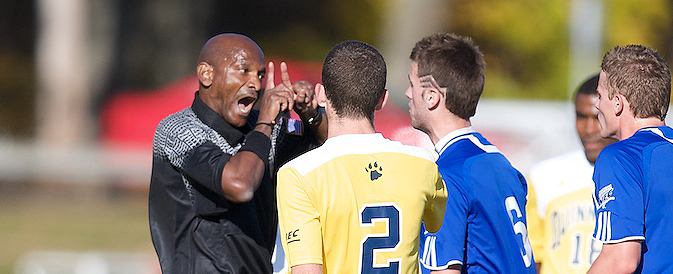
Referee decision making during a game, is a fascinating and fraughtly complex area. Referees will approach, and deal with decision-making in their own individual ways, and will often rely on a combination of intuition and Law
facts concerning play. Some Referees are capable of making instant decisions, whilst others do not like making important decisions without having first weighed up in their minds all the relevant information. Experienced Referees rely on their 'gut instinct', and their own automatic conscious or unconscious reactions when making judgments.
Decisions made using instinct are very often proved to be correct.
Referees will make hundreds (and probably thousands) of decisions during every game. Each decision must be calculated in the very smallest fraction of time. The human mind is capable of making this quantity of decisions automatically without having to think about the rational behind each conclusion. "When a Refereeing judgment is based on opinion, the ability to execute such a decision with conviction, relies on the unquestioning outcome of the players. If you can do this within the blink of an eyelid – and do it in such an authoritative way that it must seem correct at that time (even though others may have decided differently) – then football is your oyster!" |
An astute Referee understands that there will be many decision-making situations in a game that do not neatly fit the answers provided by Law. The ability to interpret the Law is therefore an important asset in the Referee’s power. It is not only a deep understanding of the 17 Laws of Associated Football that make a good Referee. It is the decision-making ability to use the Laws as the main component, in conjunction with the further ingredients of common sense, self-assessment, and post-match debate, the ‘Spirit of the Game ‘and’ Fair Play.
There are many questions that a Referee will need answers to in his career. It is no good looking to FIFA as a
single repository for ‘official’ answers because they do not have one that covers all scenarios – and to build one would constrict the human decision-making flexibility that each Referee relies on. In cases where there is no ‘black-and white’ answer to a question, an individual Referee will need to consider the opinions of others before he can feel comfortable with his own final version.
Interpretation is an individual characteristic that enables two opposing answers to both be correct. The trick is to assess all of the information and advice around you and then make your own choice. Unless specifically mentioned in the Laws (or authoritative guidance), the individual Referee’s interpretation just as correct as those
black-and-white answers provided inside the Laws themselves.
Some self-assistance and self-preparation before each game, will undoubtedly help the Referee in:
(a) making consistent decisions, and
(b) lessening the chances of the Referee becoming anxious because he is not quite sure which way to give a decision - or
(c) helping the Referee to NOT react in instances where a decision is NOT required.
This article offers an insight into the process of decision making by Referees on the field of play. It also explores psychological preparatory work that the Referee can employ with himself to help his decision making capability - particularly in those situations where it is impossible for the Referee to make a correct decision, or where a
decision is equally applicable to both teams at the same time! This article does not cover disciplinary decision-making (for example, to caution a player or not)? - But concentrates mainly on the play action of the game, and
how the Referee controls that action by the application (and interpretation) of the Laws.
There are three main types of decision that a Referee will need to take during a game.
1. Statutory decisions: (The Laws of the Game)
2. Interpretation decisions: (How the Referee interprets the Laws)
3. Impossible decisions: (A 'best guess' or 'benefit-of-the-doubt' or equal decision)
