Coaching Pointers:
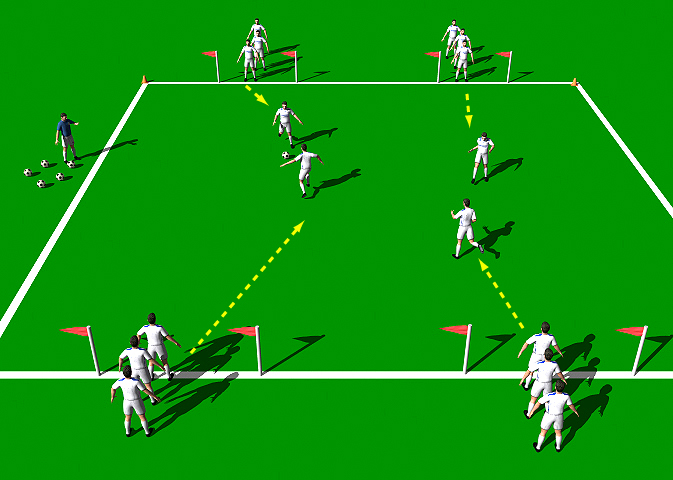
Divide your entire team into 4 groups of players. Place a group at each goal, marked by flag poles (see diagram above).
The practice begins with 2 players attacking from one side and 2 players defending from the opposite side. The attacking pair has to try and score through the 2 goals marked by the flag poles. The defenders have to prevent them from scoring. After the attack has ended, the drill is repeated from the opposite side. 2 attackers play against 2 defenders from the opposite side.
The Pressurizing Defender (1st defender):
The nearest player to the ball is the pressurizing defender. They must keep a distance of approximately 1-2 yards from the attacker.
The Supporting Defender (2nd defender):
The supporting defender role is to add cover an balance to the defensive shape. Cover is important so they are in a position to add depth for the pressurizing player. For example in a game if the pressurizing defender is beaten then the covering player would be in a position to put pressure on the attacker or clean up and mistakes. Balance is important to prevent any through balls in behind the defense. By dropping off at an angle the defender encourage
the player with the ball to make a pass in front on the defender and not behind.
The supporting player should be in a position to cover the pressurizing defender and mark their own player.
The coach should emphasize the following coaching points:
-
 Players should adjust their defensive positioning quickly as the ball is exchanged between the attackers. Players should adjust their defensive positioning quickly as the ball is exchanged between the attackers.
-
Players should adjust their position as the ball is traveling and be in a good balanced position when the attacker has the ball at their feet.
-
Communication is vital, especially from the covering defender as they can see the entire situation.
-
Bend the knees and keep the body low. (don't stand tall, stand small). This position enables the legs to be "spring loaded" to change direction quickly.
-
Leg position should be with one leg behind the other.
-
Pivot using the back foot when changing direction from side to side.
-
Keep the upper torso forward, this is crucial for changing direction from a backwards to forwards position quickly.
|